Reporting
At Key Stage Three (year 7,8 and 9) we believe that it is important that students develop the right attitude to learning. We want to reward hard work and effort. Students will receive reports home three times during the year.
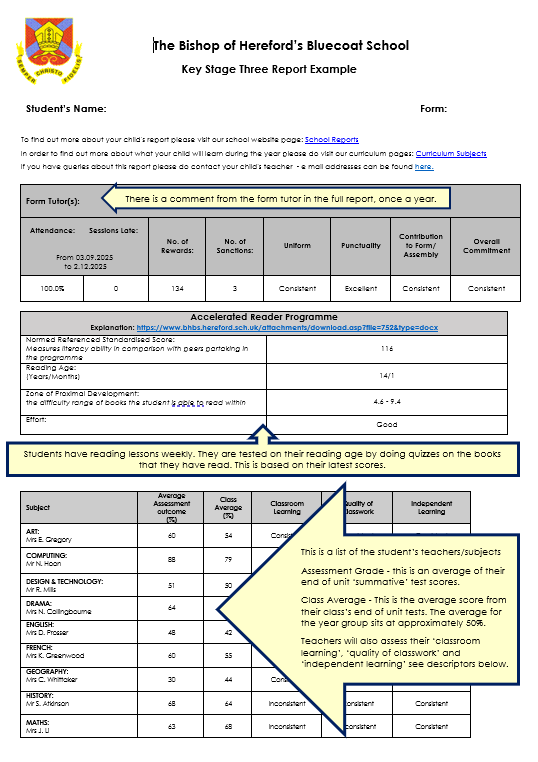
We will be giving information to you about classroom learning behaviours, the quality of their classwork and their independent learning.
Students are assessed throughout the year in a variety of ways. There is ongoing formative assessment in every classroom. Examples include things like questioning, live marking of books, quizzing, mini whiteboards in lessons, in class questions and work, mini tests, feedback in books and so on. However, students also complete in class summative assessments at the ends of larger units of work. Students will be asked to revise and prepare for these larger assessments.
Reports home will contain a summative assessment score as a percentage at Key Stage three. Some assessments will have a foundation and higher tier. These do not correlate to potential tiers of entry for GCSEs, this would be determined during GCSE courses.
Student books will detail their percentage test scores, and class average test scores. This is where students will also record their subject specific targets which are areas that they still need to improve following the assessments. This helps students to know what they have not yet learnt and therefore need to improve on. We encourage parents/carers to look at student books and to talk this through with students. We also encourage parents/carers to talk with your child about their revision preparation for these tests. They are shown how to prepare in class with things like flash cards, past questions and mind maps. You are encouraged to quiz them before the assessments on work they have been doing. Students should be aiming to get the best test scores that they can.
We also detail on school reports at key stage three how students are getting on with their reading. The accelerated reader score comes from test scores which students complete in our school library on books that they have read.
GCSE Target grades will be shared with parents in year 9 as part of the options process. From year 10 school reports will also include GCSE target grades with teacher predictions for possible GCSE outcomes added at the end of year 10.
Glossary of Terms
Key Stage Three:
Formative Assessment- An assessment during a unit of work that enables students to gain feedback in order to help them to make further progress.
Summative Assessment - The outcome of a summative assessment is a score that generates a percentage from the total. The summative assessment is an end of unit assessment (test) that students sit and teachers mark to judge the progress made in the unit of work.
Average Assessment Outcome - this is an average of their end of unit ‘summative’ assessment percentages taken during the year to date, in the subject, at the time the reports are completed.
Class Average - is the average score for all members of the teaching group in the summative assessments that have been completed to date for the named subject. The average for the year group sits at approximately 50%.
Key Stage Four:
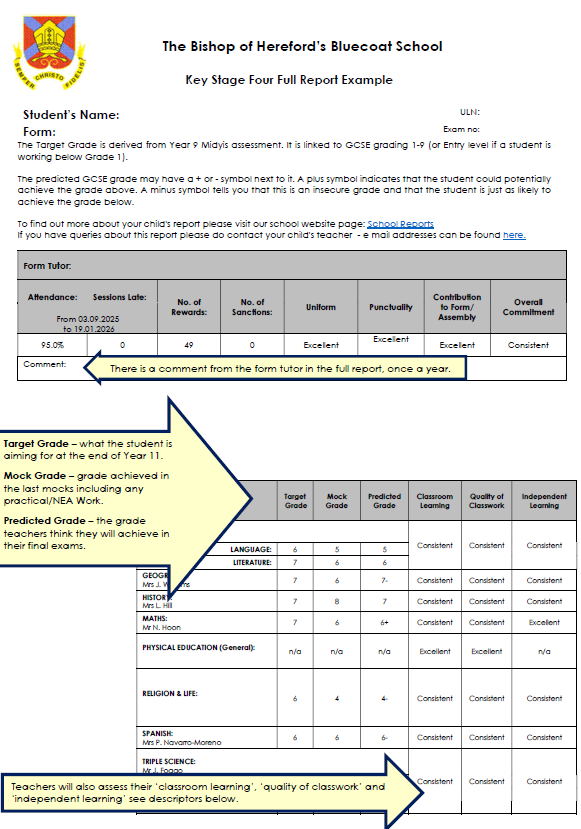
Mock grade - is the grade that they achieved in their mock – taking into account all the elements of the exam (NEA, practical and exam).
Target Grade- is the grade the student is aiming for at the end of year 11
Working at Grade- is the grade the student is currently working at, based on assessments completed so far.
Predicted Grade- is the grade that their teacher thinks they will achieve in their final exams. A minus (-) indicates this is insecure and they are as likely to achieve the grade below. A plus (+) shows they could potentially achieve the grade above.
Grades in key stage 4 are grades 9 to 1. GCSE grades 1-9 use a numerical scale where 9 is the highest (top) grade and 1 is the lowest replacing the old A*-G system to provide better differentiation, with Grade 4 as a standard pass (like the old C) and Grade 5 as a strong pass, while grades 7-9 align with A*-A grades, and 1-3 with D-G, meaning higher numbers show greater achievement.
Some courses are vocational. Vocational qualifications at Levels 1 and 2 provide practical, work-related skills for specific sectors.
Level 1 (equivalent to GCSE grades 1-3) focuses on basic, introductory skills. Level 2 (equivalent to GCSE grades 4-9) offers more advanced, specialized knowledge. Both are usually graded as Pass, Merit, or Distinction.
'Report Explainers'
Key Stage 3
Key Stage 4